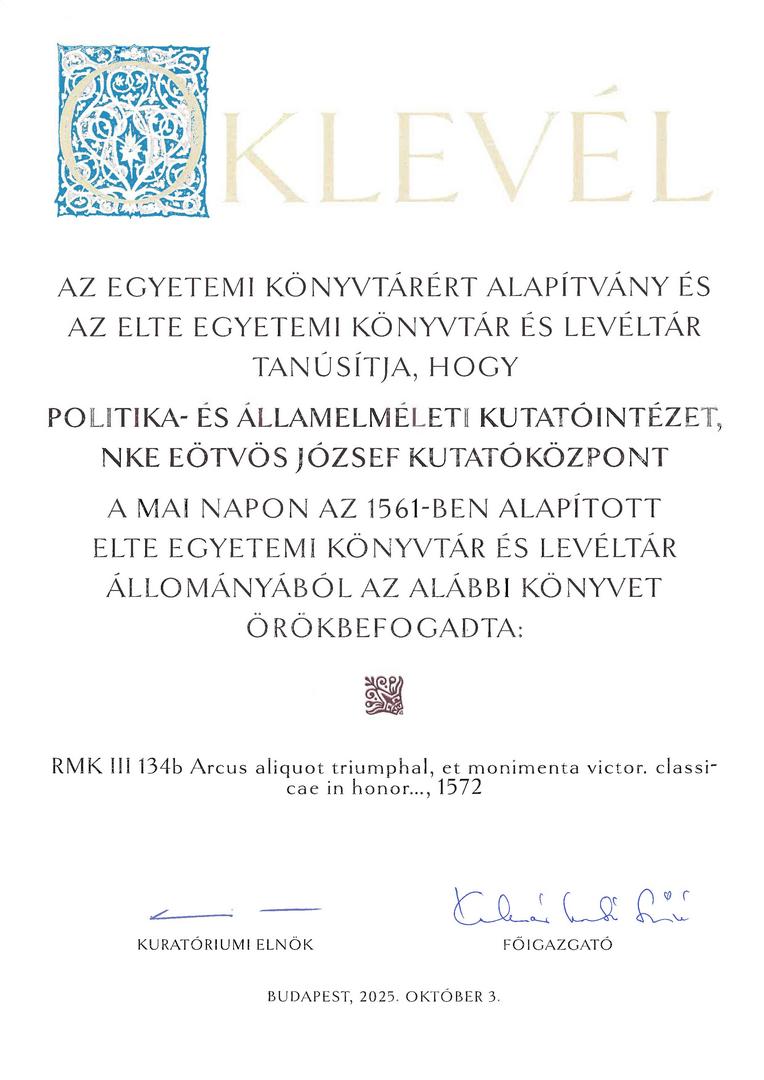
Our Institute has adopted the 1572 emblem book of Johannes Sambucus. The adoption certificate was received on behalf of our Institute by Brigitta Schvéd at the ceremonial presentation held at the ELTE University Library.
Our Institute has joined the book adoption programme of the ELTE University Library and Archives, an initiative dedicated to the protection of Hungary’s cultural heritage and the restoration of – mainly – early modern book treasures. As part of the book adoption programme, our Institute adopted Johannes Sambucus’s emblem book “Arcus aliquot triumphal, et monimenta victor. classicae in honor invictissimi ac illustris. Iani Austriae, victoris non quieturi” (Antwerp, 1572; RMK III 134/b).
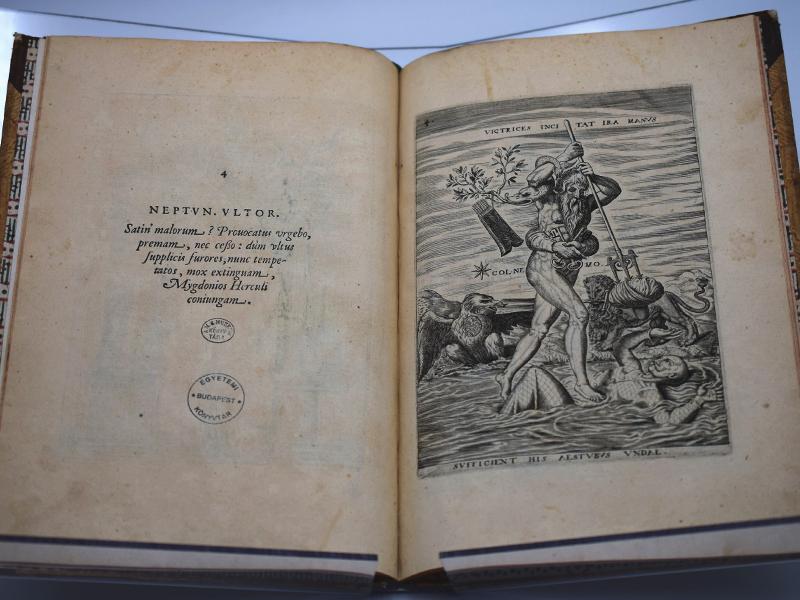
Photo: ELTE University Library
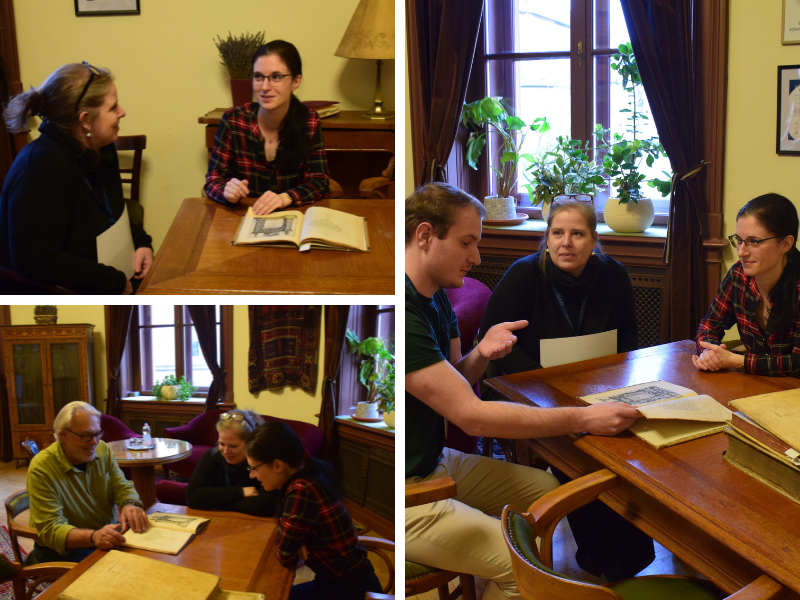
The presentation of the book and the ceremonial handover of the adoption certificate took place on 24 November 2025 in the Office of the Director General of the ELTE University Library, in the presence of Annamária Gombos Dr. Kulcsár Szabó Ernőné, Director General. Our Institute was represented by our research assistant, Brigitta Schvéd. During the presentation, the library’s rare book specialist and the conservator introduced the history, structure, and physical condition of the volume. Holding the more than 450-year-old work in one’s hands evoked not only the world of early modern humanism but also the fragility of cultural heritage preserved in book form.
Photos: ELTE University Library
Johannes Sambucus – János Zsámboky (1531–1584) – was one of the most prominent figures of 16th-century Hungarian humanism: a physician, poet, historian, and imperial court scholar. Although he spent most of his life in Vienna, he maintained close ties with Hungarian aristocrats and scholars, and the (Hungarian) humanist tradition was a consistent presence in his work. His international reputation was grounded primarily in his emblem books. His most famous work, the Emblemata (first edition: 1564), printed by Christopher Plantin, became widely known across Europe; the volume adopted by our Institute is one of its thematic continuations.
The emblem book was one of the most intriguing literary and visual genres of the early modern period. It combined images, mottos, and explanatory verses or prose texts to guide moral and humanist interpretation – as if each emblem were a miniature allegory in which text and image together unfold a lesson on virtue, exemplarity, or political meaning. Although the genre was most frequently cultivated by Jesuit and Piarist authors in the 16th–17th centuries, Sambucus developed a unique profile as one of the foremost representatives of the secular, humanist branch of emblem literature rooted in classical learning.
Published in Antwerp by Philips Galle in 1572, the adopted volume includes sixteen engravings and a heroic poem by the Netherlandish physician-humanist Hugo Favolino. As highlighted during the presentation, contemporaries interpreted the work as a tribute to John of Austria, the victorious Spanish general of the Battle of Lepanto (1571). The richness of the visual material is striking: triumphal arches decorated with mythological figures, allegories of military virtues, humanist inscriptions and quotations, and even contemporary references such as Ottoman attire, all reflecting the complex geopolitical horizon of the 16th century. The work belongs to the apologetic literary tradition that celebrated the heroes of Lepanto through the symbolic language of classical antiquity.
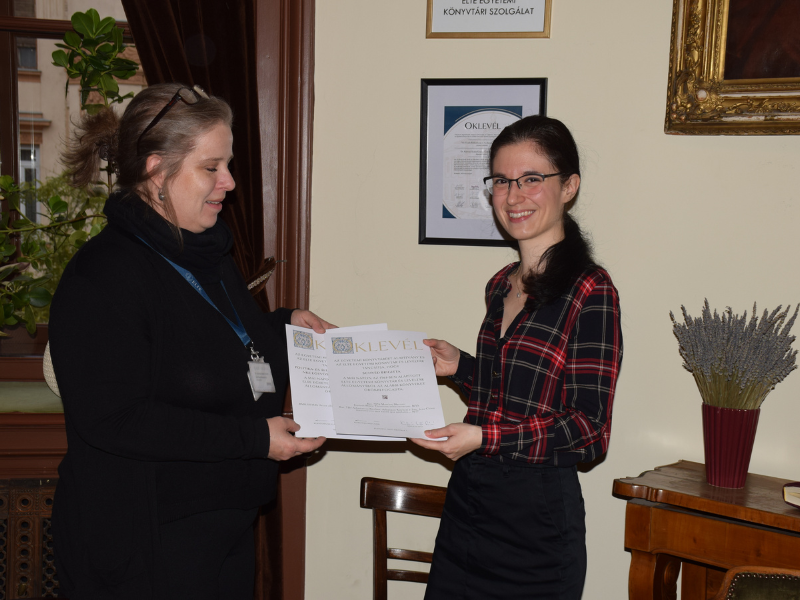
Photo: ELTE University Library
For our Institute, participating in the book adoption programme of the ELTE University Library carries a dual significance. On the one hand, it represents a commitment to the preservation of Hungary’s book culture: early modern printed works are increasingly fragile, and every restoration project is an investment in safeguarding our shared heritage for the future. On the other hand, it is a gesture of intellectual continuity, as Sambucus’s name and oeuvre are closely linked to the humanist traditions that form an important stratum of the history of political thought and cultural history – areas central to the Institute’s research profile. For these reasons, taking part in the adoption programme is not merely cultural patronage but also a symbolic act of sustaining historical consciousness and the transmission of values.